Thursday, April 2, 2015

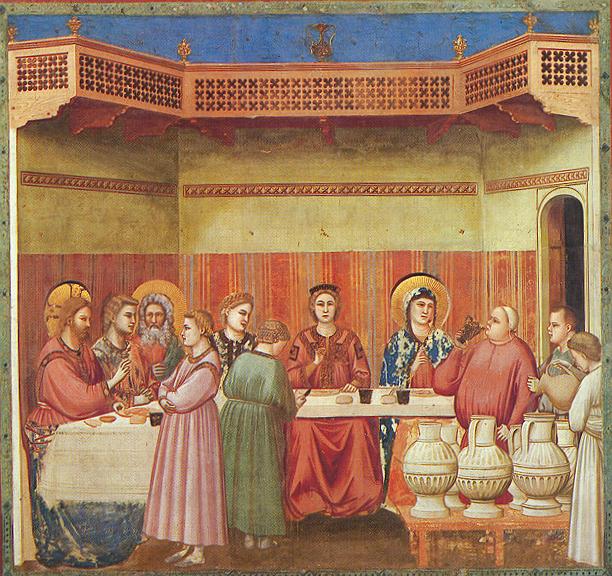
Giotto: Holy Thursday


The devil had already induced Judas, son of Simon the Iscariot, to hand him over. So, during supper, fully aware that the Father had put everything into his power and that he had come from God and was returning to God, he rose from supper and took off his outer garments. He took a towel and tied it around his waist. Then he poured water into a basin and began to wash the disciples’ feet and dry them with the towel around his waist. He came to Simon Peter, who said to him, “Master, are you going to wash my feet?” Jesus answered and said to him, “What I am doing, you do not understand now, but you will understand later.” Peter said to him, “You will never wash my feet.” Jesus answered him, “Unless I wash you, you will have no inheritance with me.” Simon Peter said to him, “Master, then not only my feet, but my hands and head as well.” Jesus said to him, “Whoever has bathed has no need except to have his feet washed, for he is clean all over; so you are clean, but not all.” For he knew who would betray him; for this reason, he said, “Not all of you are clean.”  (John 13:2-11)
One thing about writing these posts is that I notice things in scripture that I never noticed before. I don't think that I ever noticed that Judas was still present when Jesus washed the disciples feet. When I get a minute, I'm going to sit and think about that for a while. If you look at the picture above, at first it looks like there are only eleven disciples present, but then you can see the twelfth halo in the upper right-hand corner. At first I thought this was Judas, hiding, but then I saw Judas on the right-hand side with a misshapen halo that is black. From my reading, I believe that the halos of the other disciples were originally silver but have darkened over the years.

This fresco of the Last Supper is the one from which I posted the detail on Tuesday.


And the last event of the evening.


I wish I had more time to write about this one, but this kiss may be Giotto's most famous picture. Once again, look how intensely Jesus and Judas look into each other's eyes. What must they have been thinking? And look at Peter on the left, cutting off the soldier's ear from behind. Is that one of the chief priests richly dressed in pink and gold lace in the lower right corner? And what are we to make of that mysterious hooded figure with his back to us, holding onto the cloak of an escaping disciple? 
Now a young man followed him wearing nothing but a linen cloth about his body. They seized him, but he left the cloth behind and ran off naked. (Mark 51-52)


The high priest questioned Jesus about his disciples and about his doctrine. Jesus answered him, “I have spoken publicly to the world. I have always taught in a synagogue or in the temple area where all the Jews gather, and in secret I have said nothing. Why ask me? Ask those who heard me what I said to them. They know what I said.” When he had said this, one of the temple guards standing there struck Jesus and said, “Is this the way you answer the high priest?” Jesus answered him, “If I have spoken wrongly, testify to the wrong; but if I have spoken rightly, why do you strike me?” Then Annas sent him bound to Caiaphas the high priest. (John 18:19-24)
The high priest rose before the assembly and questioned Jesus, saying, “Have you no answer? What are these men testifying against you?” But he was silent and answered nothing. Again the high priest asked him and said to him, “Are you the Christ, the son of the Blessed One?” Then Jesus answered, “I am; and ‘you will see the Son of Man seated at the right hand of the Power and coming with the clouds of heaven.’” At that the high priest tore his garments and said, “What further need have we of witnesses? You have heard the blasphemy. What do you think?” (Mark 14:60-63)

All pictures are from the Web Gallery of Art.

AMDG


Wednesday, April 1, 2015

Giotto: Spy Wednesday

Judas' Betrayal
From today's gospel:

One of the Twelve, who was called Judas Iscariot, went to the chief priests and said, “What are you willing to give me if I hand him over to you?” They paid him thirty pieces of silver, and from that time on he looked for an opportunity to hand him over.
Matthew 26:14-16

...woe to that man by whom the Son of Man is betrayed. It would be better for that man if he had never been born.” Then Judas, his betrayer, said in reply, “Surely it is not I, Rabbi?” He answered, “You have said so.”
Matthew 26:24-25

Surely those are some of the most frightening words ever said.

~ ~ ~ ~ ~ ~ ~

I hope that you can enlarge this picture (click once) enough so that you can see the expressions on the faces. It looks very much like every shady deal that ever took place in a back room. Judas has Cassius's lean and hungry look. The evil one looks almost comic at this size, but not so much magnified. On a website called Everything2, I found an article that says:
...this strange image of the Devil is notable for the manner in which it echoes the figure of Judas (or vice versa), especially in the positioning of the head, hands and beard, as well as the arches of his shoulder and lower torso, which correspond to the curves of Judas’ robe.  
Although I think the author draws the wrong conclusion from this (that the devil is purely figurative), I can see what he's talking about. And what is that black shape over Judas' head? Is it a black halo, and is the reason we can't see the rest of it because the picture was damaged in some way where there appears to be a crack in the plaster? I was looking for some commentary on that when I found the above article. One interesting thing about this picture is that the frescoes in the chapel are arranged in three ranks and in chronological order. This image is out of order, coming after and not before the Last Supper. This places it on the front wall of the nave, just to the left of the sanctuary. Is is just opposite the fresco of the Visitation, and you can see, very similar in style and color--two very different sorts of meetings.


See how the color of the robes in each picture is almost a mirror image or the other. There's even a dark space behind St. Anne. And in both pictures, look how they are looking into each other's eyes.

When I started posting these frescoes by Giotto, I thought that it would be much less time-consuming than posting all of Fra Angelico's pictures last year, and it will be because there are fewer pictures and I don't have to translate Latin. Still, it is taking up much more time than I thought it would because I keep having questions about the artwork, and the questions lead me to more and more information that I find fascinating.

All pictures are from the Web Gallery of Art.


AMDG

Tuesday, March 31, 2015

Giotto: The Betrayers

Detail from The Last Supper
From today's gospel:

Reclining at table with his disciples, Jesus was deeply troubled and testified, “Amen, amen, I say to you, one of you will betray me.” The disciples looked at one another, at a loss as to whom he meant. One of his disciples, the one whom Jesus loved, was reclining at Jesus’ side. So Simon Peter nodded to him to find out whom he meant. He leaned back against Jesus’ chest and said to him, “Master, who is it?” Jesus answered, “It is the one to whom I hand the morsel after I have dipped it.” So he dipped the morsel and took it and handed it to Judas, son of Simon the Iscariot. After Judas took the morsel, Satan entered him. So Jesus said to him, “What you are going to do, do quickly.”
John 13:21-27

Simon Peter said to him, “Master, where are you going?” Jesus answered him, “Where I am going, you cannot follow me now, though you will follow later.” Peter said to him, “Master, why can I not follow you now? I will lay down my life for you.” Jesus answered, “Will you lay down your life for me? Amen, amen, I say to you, the cock will not crow before you deny me three times.”
John 13:36-38

~ ~ ~ ~ ~ ~ ~
In this detail from The Last Supper from the Arena Chapel, we see Judas in the lower left-hand corner dipping his hand in the dish with Jesus. We see John reclining at Jesus' side and it appears that the figure in the upper right-hand corner is perhaps nodding. This figure is very similar to Giotto's portrayal of St. Peter in the Upper Church, San Francesco in Assisi.

This scripture brings Judas and Peter into close contrast. Judas knows that he is the betrayer, his price is thirty pieces of silver, and once he is discovered, he leaves. Jesus challenges Peter in much the same way he does Judas, but Peter does not know himself, or what the price of his betrayal may be.

Like Peter, we can never be too sure what our price is. Jesus says, "one of you," but in truth, we are all that one.

All pictures are from the Web Gallery of Art.


AMDG

Monday, March 30, 2015

Giotto: The Raising of Lazarus

Raising of Lazarus
The large crowd of the Jews found out that he was there and came, not only because of him, but also to see Lazarus, whom he had raised from the dead. And the chief priests plotted to kill Lazarus too, because many of the Jews were turning away and believing in Jesus because of him. (John 12:9-13)
This reading from today's gospel comes directly before Jesus's entry into Jerusalem in John's gospel. I had never noticed until I read this last night, on Palm Sunday, that the gospel gives one of the reasons for the large crowds that came to welcome Jesus as a desire to see the man who had been raised from the dead. Also, we can see in the plotting of the chief priests to kill Lazarus, a portent of what can be expected by those who are associated with the mission of Jesus in the future.

Giotto's portrayal of Jesus in the above picture and in the picture from yesterday are almost identical. The slight differences in color may have to do with differences in the photos and not in the actual pictures. You also see an almost identical representation of Jesus in fresco of the Marriage at Cana.


You can see that Jesus's robe in the picture on the left has much less blue in it than the one on the right. The presentation from the Kahn Academy explains that except for the blue parts, the fresco used is buon fresco which means that the plaster was still wet when the color was applied, and is therefore a part of the actual wall. The blue is fresco secco, which means that the plaster was already dried when the blue was applied. The blue color is made from lapiz lazuli which was very expensive, and the patron of the chapel, Enrico Scrovegni wanted to use fresco secco because it required less lapiz lazuli. Because this method was used, much of the blue has flaked off over the years.

All pictures are from the Web Gallery of Art.

AMDG


Sunday, March 29, 2015

Giotto: Palm Sunday

Entry Into Jerusalem
So they brought the colt to Jesus and put their cloaks over it. And he sat on it. Many people spread their cloaks on the road, and others spread leafy branches that they had cut from the fields. Those preceding him as well as those following kept crying out: “Hosanna! Blessed is he who comes in the name of the Lord! Blessed is the kingdom of our father David that is to come! Hosanna in the highest!”   (Mark 11:7-10 

Last year during Holy Week, I posted paintings by Fra Angelico (unfortunately this link will show Easter first, so you'll have to scroll to the end to get to Palm Sunday). Most of the paintings were from the Armadio degli Argenti, which is described in one of these posts. This year I thought I'd do the same with frescoes by Giotto from the Cappella degli Scrovegni in Padua, also known as the Arena Chapel because it's next to the arena.


There is a wonderful four-part series from Khan Academy about the Scrovegni Chapel here. It takes a while to watch, but if you are at all interested, it is well worth the time.

Giotto was probably the first painter in the 14th century to move away from the Byzantine style of art that had been favored for the past two centuries. Although he was not as skilled as Fra Angelico at portraying the human figure with accuracy (see the detail from Entry into Jerusalem below), his work is quite beautiful and detailed--and then there is that lovely blue which I will write about later in the week.


Note the rather squat roundness of this character who has climbed a tree to watch Christ's triumphal procession. I can't even tell if this is a man or woman, child or adult, human or angel. Look at that almost comic foot and the face looks like it is carved from wood. Nevertheless, there is something charming about the figure, and the branches of the tree are lovely.
~ ~ ~ ~ ~ ~ ~
Giotto's life was also quite different from that of Fra Angelico who was a Dominican Friar. Giotto was a married man and a father and was quite wealthy. Their work is quite similar, though, in subject matter and in the setting of the scenes of the Bible narrative.

Unless otherwise noted, all the pictures in this series were found at the Web Gallery of Art.

AMDG


Thursday, February 26, 2015

White


I'm sure that for the first few days that Narnia was frozen, everyone thought that he was living in the Magic Kingdom. Although we have had this much snow (4-5 inches) a few times in the 13 years that we've been living in rural Mississippi, this is the first time that we have been able to get our car out of our driveway before a good bit of the snow melted, and so this morning was the first time we've driven down these country roads when every tree and field was still heavy with snow. I kept making Bill stop the car so I could take pictures--just one more! I was wishing that I could just take the morning off and drive around with our good camera, but I've already missed more days than I can keep track of because of the weather--ice until now--so I thought I better not. So, I had to make do with the camera on my Kindle Fire, which is too bad because everything was so much more beautiful than it looks here.

We pray the rosary on the way to work in the mornings, and this morning when we got to The Transfiguration I thought, "Well, that's what this is for sure." I had been looking out the window in my kitchen door earlier and feeling like Dorothy Gale--like my house had been picked up in the night and moved to a different world.

Outside my kitchen door. There's a little wood out there on the horizon, 
but the fog made it disappear.


From the driveway


The rest of these were taken on the way


You can tell from these two that there was quite a bit of fog.


After I took this one, Bill suggested I roll down the window. It was a disappointing picture, but I also find it fascinating because if I didn't know that it was a color picture, I'm not sure you could convince me that it was a color picture.


I have always loved this tree, and never more than today.


Usually, I really like the background of my posts because it compliments almost every picture. These pictures are the exception. If you click on one of them (only once!) it will take you to a slideshow of enlargements of the pictures and they look better on the black background.

As when Peter, James and John had seen Christ transfigured, they had to come down from the mountain and get back to their humdrum lives, so do we. This is what we came home to this evening.

This is the same shot as that third picture.


By the way, this is the most snow I saw in one place during the 30 mile drive home.

AMDG